

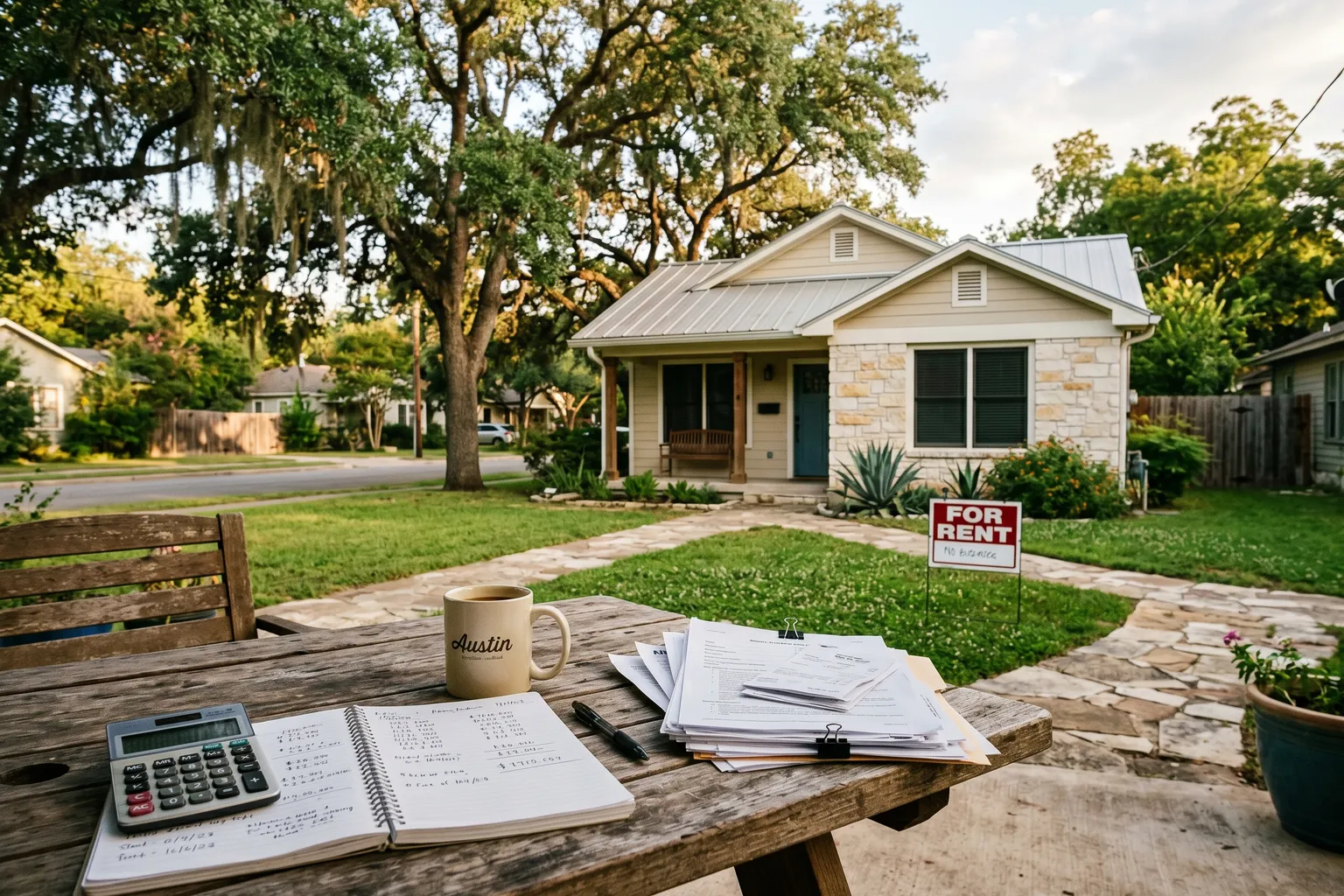
On a $400,000 Austin single-family rental pulling $2,800 a month in rent, your real non-mortgage operating costs in 2026 will land somewhere between $18,000 and $25,000 a year. Gross rent is $33,600. So before you ever touch a mortgage payment, you are netting $8,000 to $15,000 (and that is if you actually fund a capex reserve like a grown-up, which most owners don’t).
That is the math. Ed Neuhaus, broker-owner of Kendall Creek Properties (and also of Neuhaus Realty Group, a residential sales brokerage in Austin since 2007) has been doing this math with owners for 19 years. The number people quote when they say “the rent covers my mortgage so I’m cash-flowing” almost never includes the seven or eight line items below. That’s not me being dramatic. That’s just the Travis CAD tax bill and a roof at year 22.
So lets walk through it. Real numbers, the way I’d run them with you across a desk.
1. Property tax: Travis County is going to hurt
Travis County effective property tax rates run right around 2.0% for non-homesteaded property. On a $400,000 Austin rental, that is $8,000 a year. Williamson County tends to come in slightly lower, Hays County is in the same neighborhood, and the City of Austin ISD portion is the biggest chunk regardless of where you sit.
Here’s the kicker that bites new investors: you don’t get a homestead exemption on a rental. The homestead exemption (and the 10% appraisal cap that comes with it) only applies to your primary residence. The moment you turn a house into a rental, you lose both protections. Your taxable value can swing up with the market, no cap.
I’ve had owners call me in January wondering why their escrow shortage notice doubled. The answer is almost always “you bought it as a homestead and then rented it out and the appraisal district caught up.” Texas appraisal districts do find out. Sometimes through utility records, sometimes through MLS history, sometimes through neighbors. The protest process helps at the margin but a 2% effective rate is a 2% effective rate. Bake it in.
Sources: Travis County Tax Office, Travis CAD.
2. Landlord insurance: not the same policy you had when you lived there
A standard homeowner’s policy (HO-3) does not cover a tenant-occupied property. You need a dwelling fire policy, usually a DP-3. Liability coverage and dwelling coverage. On a $400,000 Austin SFH in 2026, expect $1,800 to $2,400 a year, sometimes more depending on roof age and how close you are to brush.
A few things that catch people off guard:
- The DP-3 premium is typically 15% to 25% higher than the HO-3 they had when they lived in it
- Loss-of-rents coverage is a rider you actually want, not a luxury
- After the freeze events and the hail seasons we’ve had, carriers are tightening up. Roof age matters. So does claims history.
If your insurance agent renews the old HO-3 because nobody told them you moved out, you have an uninsured loss waiting to happen. Tell your agent. Get the DP-3 in writing.
3. Capex reserve: the line item every owner skips
This is the one. The roof, the HVAC, the water heater, the exterior paint, the flooring. These are not “if” expenses, they are “when” expenses. The honest move is to set aside a piece of every rent check so you are not writing a $14,000 check the August your AC quits.
Realistic Austin replacement cycles and rough 2026 costs:
- Roof: 20 to 25 years. Composition shingle replacement $12,000 to $18,000 on a typical SFH. More if you have any kind of architectural roofline.
- HVAC: 12 to 15 years. Full replacement $8,000 to $14,000 depending on tonnage and SEER. After our summers, the bottom end of that range is rare.
- Water heater: 10 to 12 years. $1,500 to $2,500 installed (tankless higher).
- Exterior paint: 8 to 10 years in Austin sun. $4,000 to $8,000.
- Flooring: turnover-based, not time-based. Carpet $2 to $3 a square foot installed, LVP $5 to $8.
Rule of thumb I give owners: set aside 5% to 10% of annual rent in a capex reserve. On $2,800 a month rent, that is $1,680 to $3,360 a year going into a separate account that you do not touch for anything else. Ever. (Well, ok, you can touch it when the roof goes. That’s the whole point.)
The owners who get crushed are the ones who treat positive cash flow as spending money for nine years and then act surprised when year ten hands them a five-figure bill. Kahneman’s whole thing in Thinking Fast and Slow is that we are biased toward what’s salient and immediate, not what’s statistical and inevitable. A roof at year 22 is statistical and inevitable. Plan accordingly.
4. Vacancy: 4 to 6 weeks per turnover is the honest number
Austin rental days-on-market in 2026 has stretched out. For a well-priced, properly prepped SFH in a desirable submarket, plan on 4 to 6 weeks between tenants on a typical 2 to 3 year tenancy.
Lets do the smoothed math. If you turn over every 30 months and lose 5 weeks each time, that is roughly 3% to 5% effective vacancy averaged across the hold period. On $2,800 monthly rent, that smooths out to $1,000 to $1,700 a year.
Some honest truth here: owners who chase the top of the market on rent get longer DOM. Owners who price at fair market or slightly below get better tenants who stay longer. Lower rent, lower vacancy, lower turnover cost. The math usually favors the lower rent. I know that feels backwards. Run it on your own property and you’ll see.
5. Turnover cost: every move-out has a bill
Every time a tenant leaves you’ve got a list. Paint touch-up or full repaint. Carpet clean or replace. Re-key the locks (non-negotiable, this is a Texas Property Code Section 92.156 thing). Repairs that fell outside what the deposit can cover. Marketing photos. Listing. Showings.
Realistic per-turnover cost on a $400k Austin SFH: $1,500 to $4,000. Sometimes more if the tenant lived there a long time and you need a full refresh. Painters, cleaners, and HVAC servicing have all gotten more expensive in Austin, no big deal right, except it adds up.
If you’re amortizing that across a 30-month tenancy that is another $600 to $1,600 a year of cost the gross-rent number is hiding from you.
6. HOA: Austin’s quiet line item
A lot of Austin SFH neighborhoods carry an HOA. Ranges I see:
- Standard suburban HOA: $300 to $800 a year
- Amenitized (pool, gym, clubhouse): $800 to $1,500 a year
- High-end gated: $2,000+
Most leases pass through nothing to the tenant on HOA, so it sits with the owner. Always pull the HOA dues and the resale certificate before you buy a rental. Some HOAs also have rental restrictions or lease registration fees you don’t find out about until your tenant is already there.
7. Lawn, pool, pest: the owner-paid services
This depends entirely on what the lease says. In a single-family Austin lease I generally recommend the owner cover:
- Pool service if there is a pool: $150 to $250 a month, $1,800 to $3,000 a year. (And lets be honest, you want a pro on that, not a tenant who YouTubed it.)
- Pest service: quarterly, $400 to $600 a year. Cheap insurance against termite or wood-destroying-insect findings at the next sale.
- Lawn: judgment call. Some owners pass this to the tenant, some keep it to protect curb appeal. $1,200 to $2,400 a year if owner-paid.
Total owner-paid services typically run $1,200 to $3,000 a year depending on what amenities the property has. A house without a pool and with tenant-paid lawn lands at the bottom of that range.
8. Property management fee: what we charge and why
If you’re hiring a PM, Austin market rate is 8% to 12% of collected rent plus a leasing fee in turnover years. At Kendall Creek Properties our PM service is 10% of collected rent, so on $2,800 monthly rent that is $280 a month, or $3,360 a year. The leasing fee on a new tenant placement is typically one month’s rent (and that pays for screening, marketing, showings, application processing, and lease execution). Pro-rated over a 30-month tenancy, that’s another $1,100ish a year.
So all-in PM cost on this hypothetical property runs about $4,000 to $4,500 a year.
Is that worth it? That’s the question every owner asks. The honest answer is “it depends on what your time is worth and how much you enjoy 11pm toilet calls.” I’ve done deeper math on this in our property management fees article and in when to hire a property manager in Austin. If your hourly rate at work is north of $75 and the property is more than 20 minutes from your house, the math usually pencils out in favor of hiring it out. (And yes, I’d argue that. I run a PM company. But I’d argue it whether I ran one or not.)
9. The good news: most of this is deductible
I am not your CPA. But the mortgage interest, the property tax, the insurance, the management fees, the repairs, the depreciation on the structure, the professional fees, the mileage to and from the property, the supplies, the HOA dues, all of it is generally deductible against rental income on Schedule E. The depreciation piece in particular is the line item that turns “I broke even on cash flow” into “I had a paper loss for tax purposes.”
We have a fuller piece on this here: Texas rental property tax deductions. Pair this article with that one and you’ll have the full operating picture.
The math, all together
Lets stack it up on a $400,000 Austin SFH with $2,800/month rent ($33,600 gross):
| Cost line | Low estimate | High estimate |
|---|---|---|
| Property tax (Travis ~2.0%) | $7,500 | $8,500 |
| Landlord insurance (DP-3) | $1,800 | $2,400 |
| Capex reserve (5-10% of rent) | $1,680 | $3,360 |
| Vacancy (smoothed) | $1,000 | $1,700 |
| Turnover cost (amortized) | $600 | $1,600 |
| HOA | $300 | $1,200 |
| Lawn / pool / pest | $1,200 | $3,000 |
| Management fee (if applicable) | $4,000 | $4,500 |
| Total annual operating cost | $18,080 | $26,260 |
Net before debt service: $7,340 to $15,520 a year. Then your mortgage takes a bite out of that.
Now you can see why “the rent covers my mortgage” misses by a mile. The rent has to cover the mortgage AND the eight line items above. The owners who don’t fund the capex reserve are running negative cash flow they haven’t realized yet, they just haven’t had the bill come due.
What this doesn’t mean
This is not me telling you Austin rentals are a bad investment. Some of the best long-term wealth I’ve watched get built in this city came from owners who bought, held, paid down the loan, and let appreciation and amortization do their thing over 15 to 20 years. Time is the greatest creator of wealth in real estate.
But the people who get hurt are the ones who never built the spreadsheet honestly in the first place. The math is the math. Run it before you buy, run it again every January, and fund the capex reserve like the mortgage payment is funded. That’s not that hard right.
Frequently Asked Questions
What is the property tax rate on an Austin rental?
Travis County effective property tax runs about 2.0% on non-homesteaded property. On a $400,000 rental that is roughly $8,000 a year. Williamson and Hays counties are in the same neighborhood. Rentals do not get the homestead exemption or the 10% appraisal cap, so your taxable value can move with the market.
Do I need different insurance for a rental property?
Yes. A standard HO-3 homeowner’s policy does not cover a tenant-occupied home. You need a dwelling fire policy, typically a DP-3, with liability and dwelling coverage. Premiums on a $400k Austin SFH usually run $1,800 to $2,400 a year. Add a loss-of-rents rider.
How much should I set aside for capex on an Austin rental?
Plan for 5% to 10% of annual rent in a capex reserve. On $2,800 monthly rent that is $1,680 to $3,360 a year. The reserve covers the inevitable big-ticket items: roof, HVAC, water heater, exterior paint, flooring at turnover.
What is a realistic vacancy assumption for Austin in 2026?
On a well-priced single-family Austin rental, plan on 4 to 6 weeks between tenants on a typical 2 to 3 year tenancy. Smoothed across the hold period that is roughly 3% to 5% effective vacancy.
How much does it cost to turn over an Austin rental between tenants?
Realistic per-turnover cost on a $400k Austin SFH runs $1,500 to $4,000. Paint, cleaning, re-key (required by Texas Property Code 92.156), repairs, marketing, and any flooring touchup. Longer tenancies usually mean higher turnover costs.
Is hiring a property manager worth it on a $2,800/month Austin rental?
Most owners net out ahead with a PM if their hourly rate at work is above about $75 and the property is more than 20 minutes from their home. Austin market rate is 8% to 12% of collected rent plus a leasing fee in placement years. We break the math down in our property management fees article.
Are these rental expenses deductible?
Generally yes, against rental income on Schedule E. Property tax, mortgage interest, insurance, management fees, repairs, depreciation, professional fees, mileage, HOA dues. Talk to your CPA. We covered the major categories in our Texas rental property tax deductions post.
Want help running these numbers on your property?
If you’ve got a rental in Austin and you want a straight read on what it’s actually costing you (and what it could be earning), reach out. We run this analysis for owners all the time, and we’ll tell you the truth even if the truth is “you’re doing fine, don’t change anything.” The math is the math.