

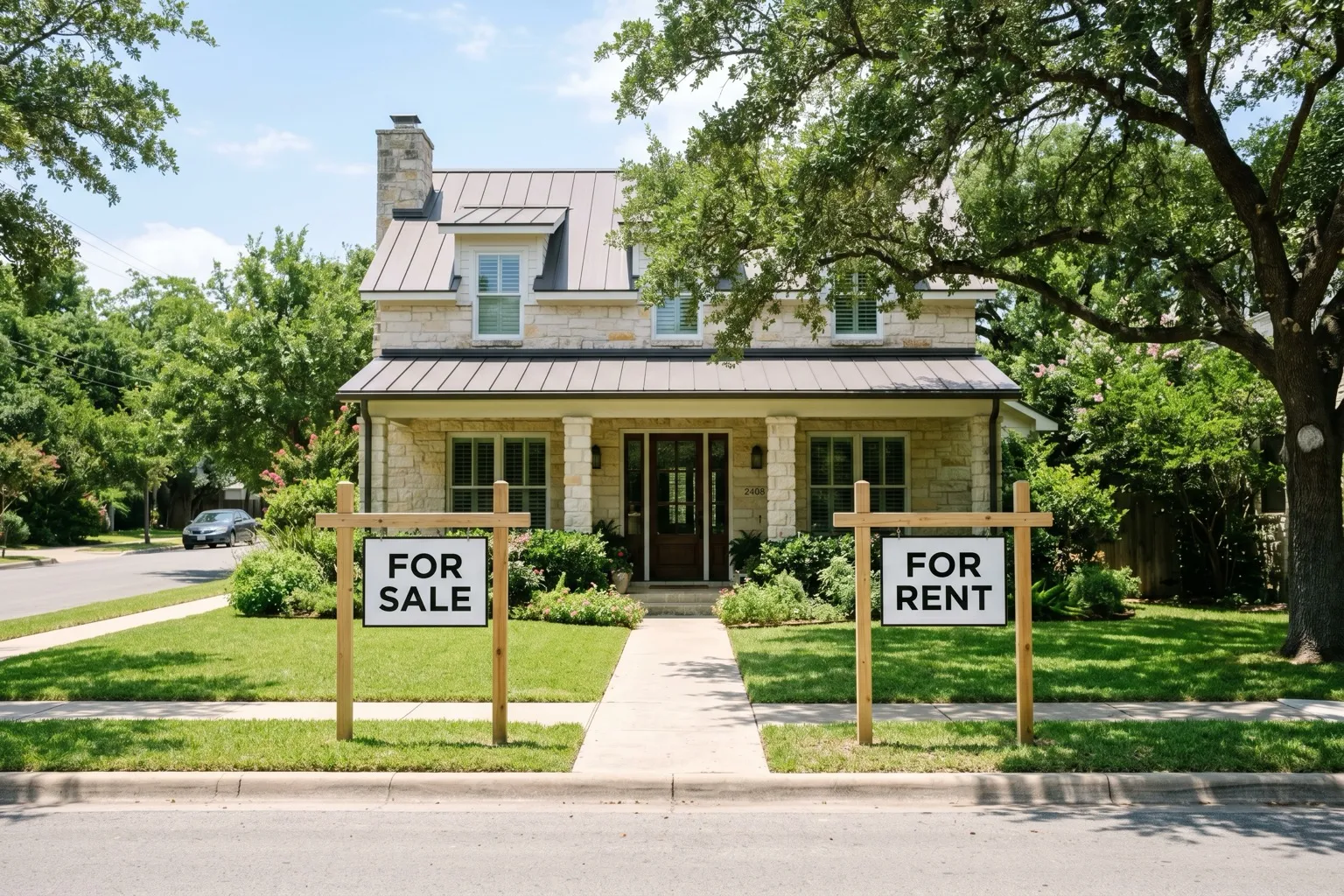
A $500,000 Austin home that rents for $2,800 to $3,200 a month is renting at roughly 0.56 percent of its value. The textbook 1 percent rule says investors should walk away from anything under 1 percent of value as monthly rent. So by the rule every real estate book on Amazon repeats, almost no central Austin single-family home should ever be a rental. And yet plenty of them are. So whats going on right.
The 1 percent rule was written for cash flow markets, not appreciation markets, and Austin has been an appreciation market for 15 years. Owners who kept rentals 2014-2022 looked like geniuses because the property doubled while a tenant covered the mortgage. Owners deciding today, with rates at 6.5 percent and Austin prices flat to down, are doing math that looks nothing like 2018. Lets walk through the actual decision.
I am the broker-owner of Kendall Creek Properties, and also the broker-owner of Neuhaus Realty Group, our sister residential sales brokerage. I see this question from both sides every week. I have owners ready to list who I talk into renting, and owners ready to rent who I talk into selling. Theres no universal answer. There IS a framework.
The 1% Rule Reality Check (Why Austin Breaks the Math)
The 1 percent rule says monthly rent should equal at least 1 percent of property value. A $500k home should rent for $5,000 a month. In Austin, a $500k central home rents for $2,800 to $3,200. That is 0.56 to 0.64 percent. Not close.
This is not temporary. Its structural. Austin home prices ran ahead of Austin wages for a decade. Rents track wages. Prices tracked migration, capital flows, and the assumption that Austin would compound at 7 percent forever. The gap between “what someone will pay to own” and “what someone will pay to rent” widened, and it has not closed.
If you are an investor scanning Austin looking for properties that hit 1 percent, you will not find them in any neighborhood you actually want to own in. Owners considering renting their CURRENT home need to know this before they run the math, because the gut-feel answer (“rentals make money”) is built on the 1 percent assumption.
Austin rentals can still be a fine investment. Just not for the reason most people think.
The Cash Flow Math on a $500k Austin Home
Lets run actual numbers on a $500,000 single-family home in central Austin renting for $3,000 a month. Mid-point assumptions, not best-case.
Gross annual rent: $36,000
Operating expenses:
- Property tax: ~$10,000 (Travis County effective rate around 2.0 percent). Check yours at the Travis Central Appraisal District site.
- Landlord insurance: ~$2,400
- Capex/maintenance reserve: ~$3,000 (HVAC, roof, water heater, paint, fence, all amortized)
- Vacancy reserve: ~$1,500
- Property management at 10 percent: ~$3,500
Total non-debt operating: ~$20,400. Net before debt service: ~$15,600 (range $13,200 to $18,000)
Now layer in the mortgage. This is where the answer flips.
Scenario A: Typical 2026 mortgage. $400,000 at 6.5 percent on a 30-year is roughly $2,528 a month, $30,336 a year. The property runs NEGATIVE $14,000 to $17,000 a year. The tenant pays you $36,000 a year and you are still writing checks. Principal pay-down builds equity (about $4,500 in year one), depreciation creates a paper loss, but on cash you are bleeding. Where that money actually goes: the hidden costs of owning a rental in Austin.
Scenario B: Free and clear. Net cash flow $13,000 to $18,000 a year on $500,000 of equity. A 2.6 to 3.6 percent cash-on-cash return. Better than zero. Worse than a Treasury bill.
Scenario C: Sub-4 percent mortgage from 2020 or 2021. $400,000 at 3.5 percent is roughly $1,796 a month, $21,552 a year. Net cash flow lands at -$2,000 to -$6,000 the first year, breakeven by year three after rent bumps, modest positive by year five. THIS is the owner who should usually rent. The cheap mortgage is irreplaceable. Sell it, lose it forever.
Before anything else, look at your rate. Your rate decides 80 percent of the decision.
Opportunity Cost: What Else Can That Equity Do
Most owners skip this part. Sell the $500k home, pay off a $300k mortgage, pay 6 percent in transaction costs ($30k), and you walk with around $170,000 cash. Free and clear, you walk with around $470,000.
What is that money worth doing nothing? A 5-year Treasury at 5 percent yields $8,500 a year on $170k, or $23,500 a year on $470k. Zero work. Zero phone calls at midnight. Zero turn costs. Zero tenant disputes.
The free-and-clear case is the one owners miss most often. They think “no mortgage means pure profit.” But the right comparison is not “rental income vs zero.” Its “rental income vs what else this $470k could do.” A 3 percent return on equity in a rental you have to actively manage is not a win against a 5 percent Treasury that requires zero attention. (Yes, Treasuries do not appreciate. Getting to that.)
The Appreciation Story (The Part That Changed)
This is where the conversation usually breaks down. Owners say “but Austin always goes up.” Then I show them the chart.
Austin metro home prices appreciated roughly 5-7 percent annually 2014 through 2022. That was the era that built the “Austin always goes up” thesis. Then 2023 happened. The Austin Board of REALTORS market reports show median prices flat to down in 2023, 2024, and 2025. Most central Austin neighborhoods are 8-15 percent below 2022 peaks. Forecasters now project 2-4 percent appreciation for Austin in 2026 and 2027.
That changes everything. At 7 percent appreciation, even a negative-cash-flow rental looks fine because appreciation covers the bleed. At 3 percent, the math is brutal. A 3 percent return on a $500k home is $15k a year of appreciation, plus $15k of net rental income (free and clear) equals $30k on $500k of equity. 6 percent total. Compare to a 60/40 portfolio averaging 7-8 percent with zero work.
The “Austin will keep going up” thesis worked at 7 percent. At 3 percent, the math no longer compensates you for the work and the risk concentration. This is the biggest mindset shift Austin owners need to make in 2026.
The Tax Math Most Owners Underestimate
Section 121 of the Internal Revenue Code lets a single owner exclude up to $250,000 of capital gain on the sale of a primary residence ($500,000 married filing jointly), if you lived in the home as your primary residence for at least two of the last five years. The IRS publication on selling your home walks through the rules.
Use it or lose it. Convert to a rental for three years and one day, and you no longer meet the residency test. You sell, you owe capital gains (15-20 percent federal, no state tax in Texas) PLUS depreciation recapture (25 percent on depreciation you should have been taking). On a $200,000 gain that could have been fully sheltered, you might pay $30,000-$50,000 in tax. Almost no owner factors this in.
Section 121 is the single best reason to sell a home you originally bought as a primary residence. Walking away from it is leaving money on the table.
The alternative is a 1031 exchange. Sell the rental, defer capital gains, roll into another rental. This works. It also locks you into rental ownership essentially forever, because every 1031 just kicks the tax can until heirs inherit at a stepped-up basis. If you might want to NOT be a landlord at some point, 1031 is not your escape valve. Full breakdown coming in 1031 exchanges for Austin rental owners.
The Non-Financial Factors (These Decide More Cases Than Math)
The numbers settle maybe 60 percent of these decisions. The other 40 percent is below.
Sentiment. “We love this house” is a real cost, and it cuts both ways. Some owners regret renting out a home they love within 12 months because strangers do not care about it the way they did. Other owners rent it out and never look back. You know which kind you are.
Distance. Moving out of state? Property management is mandatory. Self-managing from 1,500 miles away is not realistic, no matter what the YouTube gurus say. (My self-manage vs hire piece goes deeper.) Moving across town, you can probably self-manage if you want to.
Time of life. Empty nesters with paid-off houses are the demographic I most often steer toward selling. The rental ties up a huge chunk of net worth in a single illiquid asset that produces modest cash flow and requires active management. Most retirees would be better served by simplifying, deploying equity into income securities, and not getting a 2am call about a water heater.
Risk tolerance. Rentals produce lumpy returns. Most years fine. Occasional years awful: HVAC plus roof plus a tenant who stops paying plus a turn that takes three months. If a $30,000 hit in a single year would emotionally wreck you, rentals are probably not your move.
Reserves. If you do not have 6 months of property expenses in cash on top of your personal emergency fund, you should not own a rental. You will hit the bad year, you will not have reserves, and you will be a forced seller at the worst possible moment.
The Kendall Creek Take (When to Sell, When to Rent)
Sell if:
- Mortgage rate above 5.5 percent and the property will be cash-flow negative
- You have equity you want or need deployed elsewhere
- You are moving more than 30 minutes away
- You would not sleep at night with a $500k rental on your balance sheet
- You can still qualify for the Section 121 primary-residence exclusion
Rent if:
- The home is paid off OR mortgage rate is below 4 percent
- Location is genuinely rentable: good schools, walkable, low-maintenance home, stable tenant demand
- You have a 5+ year time horizon
- You have 6+ months of property expenses in reserves separate from your personal emergency fund
- You are emotionally fine with strangers living in the home
Talk to me before you decide if:
- Its genuinely 50/50 (most cases)
- Your rate is in the 4-5.5 percent dead zone where the math is close
- You are inheriting and have no urgency
- You are downsizing and trying to decide whether to keep the old place as a rental or just sell
If you sell, Neuhaus Realty Group is our sister residential sales brokerage and can run a real CMA. If you rent, we are who you would hire to manage it. Either way, we cover both sides under one roof so there is no incentive to push you toward the one we happen to do. Thats deliberate.
Frequently Asked Questions
Is the 1% rule still valid for Austin rentals?
Not in any neighborhood you actually want to own in. Central Austin single-family homes rent at roughly 0.4 to 0.6 percent of value. Investors requiring 1 percent should buy elsewhere. Austin can still work, but you have to underwrite it on total return, not pure cash yield.
Will I lose the Section 121 exclusion if I rent my home for a few years?
You lose it after the home stops being your primary residence for more than three of the last five years. You can rent for up to three years and still qualify, assuming you originally lived in it for two years. The IRS publication on selling a home has the rules.
Should I keep my home as a rental if my mortgage rate is 3 percent?
Almost always yes, if the rest of the picture works. A sub-4 percent mortgage is irreplaceable in the 2026 rate environment. Selling means losing it forever. Even a property that just breaks even at 3 percent is locked in to that financing for the next 25 years, which is a real asset by itself.
What is the average cap rate for Austin rental properties in 2026?
For central Austin single-family homes, cap rates typically run 2.5 to 4 percent. Low by national standards. Buyers are paying for expected appreciation, not pure cash flow. Outlying suburbs like Manor, Pflugerville, and Hutto run higher (4-5 percent).
Do I need a property manager if I rent out my home?
Required if you are moving out of state. Strongly recommended if you are moving more than 30 minutes away. Optional if you are staying in Austin and have the time and stomach for it. Full cost-benefit in self-manage vs hire a property manager in Austin.
Can I deduct rental property expenses on my taxes?
Yes. Operating expenses, mortgage interest, property tax, insurance, repairs, and depreciation are all deductible against rental income. Depreciation alone can shelter a meaningful portion of rental income even when the property is cash-flow positive. Full list in rental property tax deductions in Texas.
What To Do Next
First, pull your mortgage statement and write down your rate. Thats the single most important data point. Below 4 percent, your starting position is “rent unless something else makes selling obviously correct.” Above 5.5 percent, your starting position is “sell unless something else makes renting obviously correct.”
Second, run the cash flow math honestly. Mid-case, not best-case. Use the numbers above as a template.
Third, the non-financial questions. Will you be okay with strangers in your home? Will you sleep at night? Do you actually want to be a landlord?
Then reach out. We do this conversation all the time, without trying to push you one direction or the other. Sell, Neuhaus Realty Group handles it. Rent, we manage it ourselves. Both sides of the house, one decision at a time.